WAIS INSIGHT · AIRPORT RANKINGS
Megahubs: Airports Handling More Than 50 Million Passengers
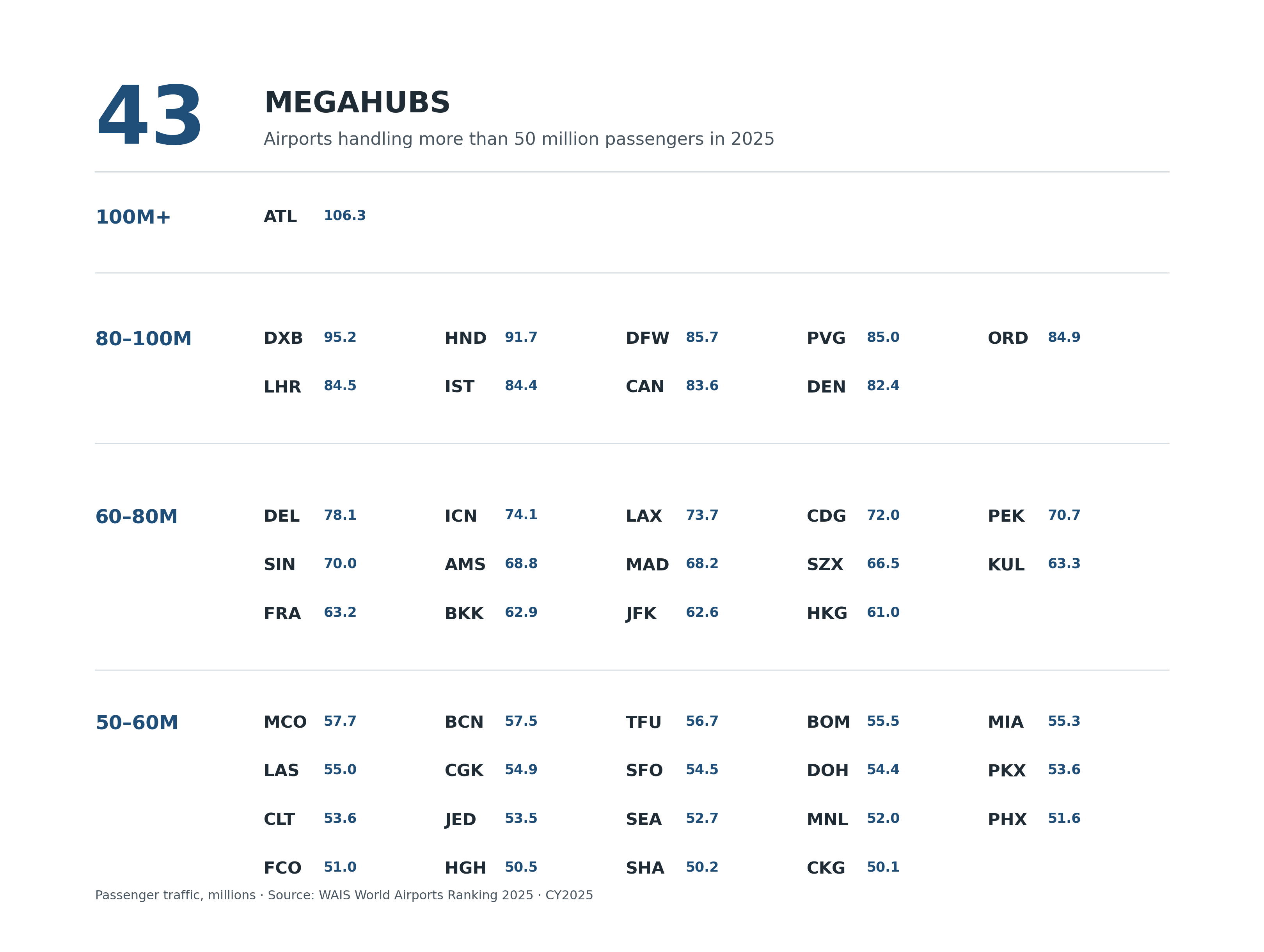
Only a small group of airports operates at the very top of the global passenger hierarchy. In 2025, 43 airports handled more than 50 million passengers, forming a distinct upper tier within the 951 airports included in the WAIS World Airports Ranking.
2025 DATA · PASSENGER TRAFFIC · 50M+ AIRPORTS
KEY FINDINGS
43
MEGAHUBS
Airports handling more than 50 million passengers in 2025.
4.5%
OF WAIS AIRPORTS
Only 43 of the 951 airports in the ranking exceeded the 50-million threshold.
106.3M
LARGEST AIRPORT
Atlanta recorded the highest passenger traffic in 2025.
10
AIRPORTS ABOVE 80M
Only ten airports reached the next level of more than 80 million passengers.
A RARE UPPER TIER
Crossing 50 million annual passengers places an airport within a very small part of the global airport system. Of the 951 airports handling at least one million passengers in the WAIS ranking, only 43 — 4.5% — exceeded the 50-million threshold in 2025.
Even within this group, traffic is strongly differentiated. Nineteen airports handled between 50 and 60 million passengers and another fourteen between 60 and 80 million. Only nine airports recorded between 80 and 100 million, while Atlanta was the only airport to exceed 100 million, reaching 106.3 million passengers.
The 50-million threshold therefore identifies a substantial upper tier, but not a uniform one. Most members sit relatively close to the threshold, while progressively fewer airports occupy the higher traffic bands. The result is a steep hierarchy even among the world’s largest airports.
GEOGRAPHY OF THE MEGAHUBS
Megahubs are a global phenomenon, but they are not evenly distributed. The 43 airports above 50 million passengers include major gateways in North America, Europe, East Asia, South Asia, Southeast Asia and the Middle East, reflecting several distinct centres of large-scale air travel.
The United States and China have particularly strong representation within the group, but the 50-million threshold is also crossed by airports serving major metropolitan and national markets across Europe and Asia. London Heathrow, Paris Charles de Gaulle, Amsterdam Schiphol, Madrid and Frankfurt form part of the European group, while Tokyo Haneda, Seoul Incheon, Singapore Changi, Bangkok Suvarnabhumi and Kuala Lumpur illustrate the geographic breadth of the Asian megahub system.
The Middle East contributes airports including Dubai and Doha, while Delhi and Mumbai represent India’s rapidly expanding airport market. The result is not a single geographic cluster but a network of exceptionally large airports embedded in different regional aviation systems.
DIFFERENT PATHS TO MEGAHUB SCALE
Passenger volume alone does not explain how an airport reaches megahub scale. Airports above 50 million passengers operate within very different combinations of domestic markets, international networks and metropolitan airport structures.
Atlanta, Dallas–Fort Worth, Denver and several other large US airports operate within an exceptionally large domestic aviation market. Dubai and Doha reach comparable scales within much smaller national markets but with a strong international network orientation. Airports such as Tokyo Haneda, Beijing Capital and Shanghai Pudong form part of very large Asian metropolitan and national aviation systems.
Megahubs also occupy different positions within multi-airport cities. London Heathrow shares its metropolitan market with five other airports in the London system, while JFK is one component of the seven-airport New York system. Beijing and Shanghai each have two airports above the 50-million threshold, demonstrating that exceptionally high passenger volumes can coexist at more than one airport within the same metropolitan system.
ABOUT THE DATA
This analysis is based on the WAIS World Airports Ranking 2025, covering 951 airports handling at least one million passengers annually across 11 world regions.
For this Insight, a megahub is defined analytically as an airport handling more than 50 million passenger movements in calendar year 2025. The threshold is used to examine the upper end of the global passenger distribution and does not constitute a separate functional airport classification within WAIS.
Passenger movements represent arriving and departing passengers, with direct transit passengers counted once where applicable. Calendar-year figures are used wherever available, following the WAIS source hierarchy and estimation rules where complete full-year figures are unavailable.
The analysis concerns individual airports. Where an airport belongs to a WAIS Multi-Airport System, its passenger traffic is shown independently rather than as part of the combined metropolitan system total.
WAIS 003 · World Airports Ranking 2025
Explore the complete global airport ranking
The full WAIS 003 publication provides global and regional rankings, geographic analysis and reference material covering 951 airports and 76 multi-airport systems worldwide.

