WAIS INSIGHT · AIRPORT SYSTEMS
One City, Many Airports: How Multi-Airport Systems Work
Many of the world’s largest urban air transport markets are served by more than one airport. WAIS treats these airports not only as individual facilities, but also as components of metropolitan airport systems whose structure helps explain how aviation is organized around major cities.
WAIS FRAMEWORK · 76 MULTI-AIRPORT SYSTEMS · AIRPORT ROLES
KEY FINDINGS
76 SYSTEMS WORLDWIDE
MULTI-AIRPORT SYSTEMS
Metropolitan airport systems identified within the current WAIS framework.
MULTIPLE AIRPORTS
ONE URBAN MARKET
A system brings together airports serving the same metropolitan aviation market.
THREE SYSTEM ROLES
PMG · AMG · MSR
WAIS distinguishes different positions of airports within metropolitan systems.
BEYOND THE 1M THRESHOLD
45 AIRPORTS
A system may include smaller airports outside the main WAIS 003 ranking.
WHY LOOK BEYOND THE INDIVIDUAL AIRPORT?
Airport statistics are normally reported for individual airports. This is essential for comparing traffic, networks and operational scale, but it can obscure an important feature of aviation geography: many major cities depend on several airports rather than one.
London, New York, Paris, Moscow and Los Angeles are obvious examples, but the same principle occurs in metropolitan markets of very different sizes and structures. Airports within these systems may serve different airlines, traffic segments, geographic markets or operational functions while remaining part of the same broader urban aviation environment.
Looking only at individual airport rankings can therefore separate facilities that are closely connected by geography and market. The WAIS Multi-Airport Systems framework adds a second analytical level: the metropolitan airport system.
It does not replace the individual airport. Instead, it allows the same airport to be examined simultaneously as an independent aviation facility and as one component of a larger urban system.
WHAT MAKES A MULTI-AIRPORT SYSTEM?
A WAIS Multi-Airport System is not defined simply by drawing a fixed-radius circle around a city. Geographic proximity alone is insufficient: neighbouring airports do not necessarily form a meaningful metropolitan aviation system.
The framework considers whether multiple airports serve the same broader metropolitan market and how they relate to the urban area and to one another. This makes it possible to distinguish genuine multi-airport systems from airports that happen to be geographically close but primarily serve different markets.
The resulting systems vary greatly in scale. Some consist of two major airports dividing a very large metropolitan market. Others contain several airports with strongly differentiated functions. The largest systems may combine major international gateways, secondary commercial airports and much smaller facilities within the same metropolitan structure.
This is why WAIS treats the system boundary as an analytical concept rather than simply a traffic threshold.
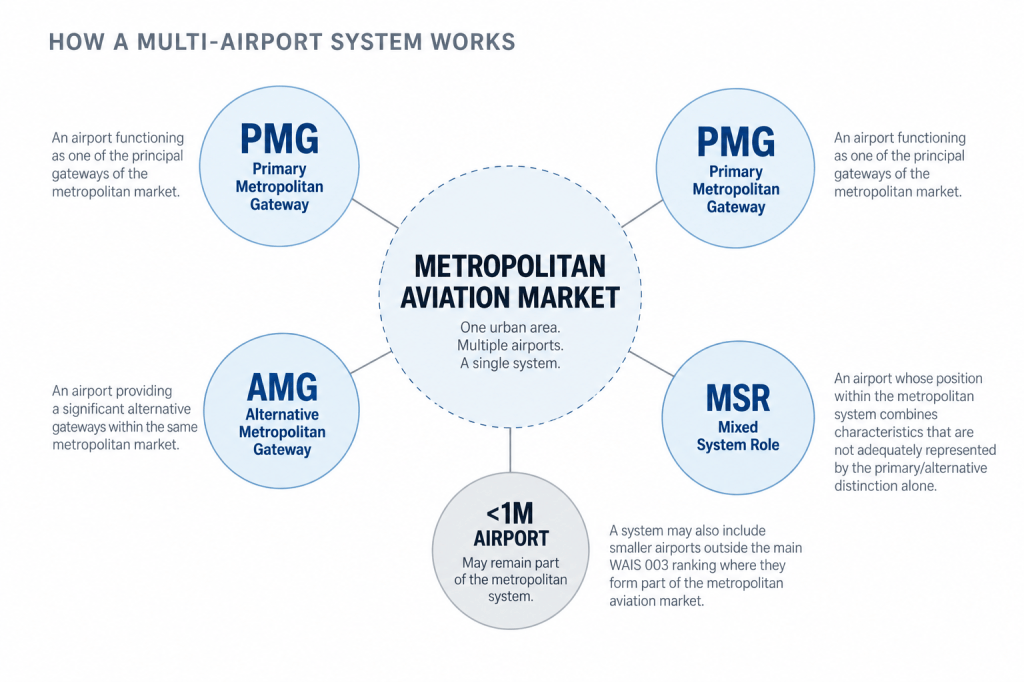
THREE ROLES WITHIN THE SYSTEM
PMG — PRIMARY METROPOLITAN GATEWAY
An airport functioning as one of the principal gateways of the metropolitan aviation market. A system may contain more than one PMG. The category therefore does not mean that every city must have a single dominant airport.
AMG — ALTERNATIVE METROPOLITAN GATEWAY
An airport providing a significant alternative gateway within the same metropolitan market. Its role may reflect network specialization, airline structure, geographic position within the metropolitan area or the distribution of traffic among the system’s airports.
MSR — MIXED SYSTEM ROLE
An airport whose position within the metropolitan system combines characteristics that are not adequately represented by the primary/alternative distinction alone. This category allows WAIS to preserve system structures that would otherwise be oversimplified by forcing every airport into a binary hierarchy.
NO SINGLE MODEL
Multi-airport systems do not develop according to one universal pattern.
In some metropolitan areas, one airport remains overwhelmingly dominant while one or more smaller airports provide alternatives. Elsewhere, traffic is divided much more evenly between two major gateways. The largest and most complex systems may contain several large commercial airports together with smaller specialized facilities.
The relationship between airports may also change over time. New airports open, older airports acquire different roles, airline networks shift and metropolitan areas expand. A multi-airport system is therefore better understood as an evolving spatial and functional structure than as a fixed collection of airports.
This diversity is analytically important. Two metropolitan areas with similar combined passenger totals may organize their airport capacity in fundamentally different ways.
SYSTEM TRAFFIC AND AIRPORT TRAFFIC
WAIS preserves a strict distinction between airport traffic and system traffic.
Individual airport passenger figures remain attached to the airport itself. When airports are analysed as a Multi-Airport System, their traffic can additionally be aggregated to describe the scale of the metropolitan aviation market.
For example, the London system handled approximately 179.3 million passenger movements across six airports in 2025. That figure describes the combined system; it does not replace the individual traffic figures for Heathrow, Gatwick, Stansted, Luton, London City and Southend.
This distinction allows the same data to answer two different questions: How large is an individual airport? and How large is the metropolitan airport market of which it forms a part?
EXPLORE: THE WORLD’S LARGEST MULTI-AIRPORT SYSTEMS IN 2025 →
WHY SMALLER AIRPORTS CAN MATTER
The Multi-Airport Systems framework is deliberately not restricted to airports handling more than one million passengers.
The main WAIS airport ranking uses the one-million-passenger threshold to create a consistent global dataset of major airports. A metropolitan system, however, may also contain a smaller airport whose traffic falls below that threshold but whose relationship to the metropolitan market is analytically significant.
Excluding such an airport solely because of its traffic volume could produce an incomplete representation of the system. WAIS therefore maintains these smaller system members separately while preserving their connection to the relevant Multi-Airport System.
This is an important distinction between a ranking boundary and a system boundary: the former determines which airports enter the principal global ranking, while the latter describes how airports are organized geographically and functionally.
FROM AIRPORT RANKINGS TO URBAN AVIATION SYSTEMS
The Multi-Airport Systems framework changes the scale at which the airport network can be examined.
At the airport level, Heathrow, Gatwick and Stansted are separate entities with their own passenger totals, airline networks and operational characteristics. At the metropolitan level, they are also components of the London airport system. Both perspectives are valid, but they describe different dimensions of aviation geography.
This dual structure is particularly useful for comparing large urban markets. It prevents a city served by several substantial airports from appearing artificially smaller simply because its traffic is divided among multiple facilities, while still preserving the individual identity and characteristics of every airport.
Multi-airport analysis therefore provides a bridge between airport-level data and metropolitan aviation geography — one of the core relationships represented within WAIS.
ABOUT THE FRAMEWORK
The current WAIS framework identifies 76 Multi-Airport Systems worldwide.
System membership and airport roles are maintained separately from the passenger ranking. Airports within a system retain their individual airport records, passenger figures, classifications and other attributes.
The framework also permits airports below the one-million-passenger threshold to be included as system members where required to represent the metropolitan airport structure. These airports are maintained separately from the principal 951-airport WAIS 003 dataset.
Multi-Airport System passenger totals are calculated by combining the traffic of their constituent airports for the relevant reference period. They should therefore be interpreted as metropolitan-system aggregates rather than as traffic recorded at a single airport.
WAIS 003 · World Airports Ranking 2025
Explore the global airport system
Explore the WAIS framework for airports, metropolitan systems and the geographic organization of global air transport.

