WAIS INSIGHT · AIRPORT CLASSIFICATION
Beyond Size: Why Airports Need Functional Classification
Passenger traffic tells us how large an airport is. It does not, by itself, tell us what role that airport performs within the aviation system. Airports of similar size can occupy very different positions in airline networks, national airport systems and global air transport.
WAIS FRAMEWORK · AIRPORT FUNCTION · CLASSIFICATION
KEY FINDINGS
TRAFFIC MEASURES SCALE
Passenger volume describes the size of an airport, not its function.
FUNCTION DESCRIBES ROLE
Airports occupy different positions within aviation networks and geographic systems.
SIMILAR SIZE ≠ SIMILAR FUNCTION
Airports with comparable traffic can perform fundamentally different roles.
CLASSIFICATION ENABLES COMPARISON
A common framework makes functional differences visible and comparable.
SIZE IS ONLY ONE DIMENSION
Airport rankings usually begin with passenger traffic. The measure is valuable because it is widely available, relatively easy to compare and provides an immediate indication of the scale of airport activity. But scale is only one dimension of an airport.
Two airports handling similar numbers of passengers may have very different network structures. One may function as a major international gateway, another as a predominantly domestic hub, another as a leisure-oriented airport and another as a secondary gateway within a large metropolitan system.
Passenger totals alone cannot represent these differences. A ranking can tell us which airport is larger, but not necessarily what position each airport occupies within the wider aviation system.
This distinction between scale and function is the starting point of the WAIS Airport Functional Classification.
AIRPORTS ARE PART OF SYSTEMS
An airport does not operate in isolation. Its function emerges from relationships with cities, regions, countries, airlines, destinations and other airports.
Some airports provide the principal international access to entire countries or regions. Others organize large connecting networks. Some primarily serve their surrounding metropolitan market, while others draw substantial demand from tourism or specialized traffic. In multi-airport cities, individual airports may also occupy different positions within the same metropolitan aviation market.
The same physical infrastructure can therefore support very different aviation functions, and similar passenger totals can arise from very different combinations of traffic and network relationships.
Functional classification shifts the question from “How much traffic does this airport handle?” to “What role does this airport perform?”
AIRPORT FUNCTIONAL TYPES
The WAIS Airport Functional Classification (AFCS) identifies an airport by its Primary Airport Function — the role that most strongly defines its position within the air transport system.
The applied classification consists of seven Functional Airport Types. They represent different forms of functional dominance and are neither a hierarchy of airport importance nor categories determined by passenger volume. Airports of comparable size may therefore belong to different functional types.
GHB
GLOBAL HUB
Global and intercontinental connecting function
A Global Hub concentrates and redistributes passenger flows across a geographically extensive international and intercontinental network. Its defining characteristic is the scale, structure and geographic reach of its connecting function rather than traffic volume alone.
NHB
NATIONAL HUB
National or major subnational connecting function
A National Hub organizes and redistributes passenger flows principally within a national or major subnational air transport system. It acts as a principal connecting node between regional markets and major domestic destinations and may also provide substantial international connectivity.
TGW
TOURIST GATEWAY
Access to major tourism destinations
A Tourist Gateway primarily provides access to a major tourism destination or tourism-oriented market. Its classification reflects the functional importance of tourism rather than passenger volume or the proportion of international traffic alone.
CAP
CAPITAL AIRPORT
Connectivity associated with a national capital
A Capital Airport primarily provides air connectivity associated with the governmental and administrative role of a national capital. Location in a capital does not itself determine classification: the capital-serving function must be more significant than a dominant hub or other specialised function.
REG
REGIONAL AIRPORT
Regional and local connectivity with the wider air transport system
A Regional Airport primarily connects a regional or local market with the wider national or international air transport system. The category is independent of traffic volume and may include both large regional airports and smaller commercial airports.
ISL
ISLAND AIRPORT
Structurally important external connectivity for an island community
An Island Airport provides a structurally important external air-connectivity function for an island or island community. Its classification reflects dependence on aviation for overcoming geographic separation rather than island location alone.
CGO
CARGO AIRPORT
Dominant freight and logistics function
A Cargo Airport primarily performs the movement, handling and distribution of air freight. Its classification depends on the functional dominance of cargo and logistics activity within the airport’s operations rather than absolute cargo volume alone.
RESERVED CATEGORIES
AFCS also provides four reserved categories for extension of the classification to a broader range of aviation facilities.
MIL
Military Airport
GEN
General Aviation Airport
HEL
Heliport
Applied types and reserved categories serve different purposes. The seven applied types constitute the current operational core of AFCS, while the four reserved categories provide for future extension beyond its present application to major commercial airports.
FROM RANKING TO CLASSIFICATION
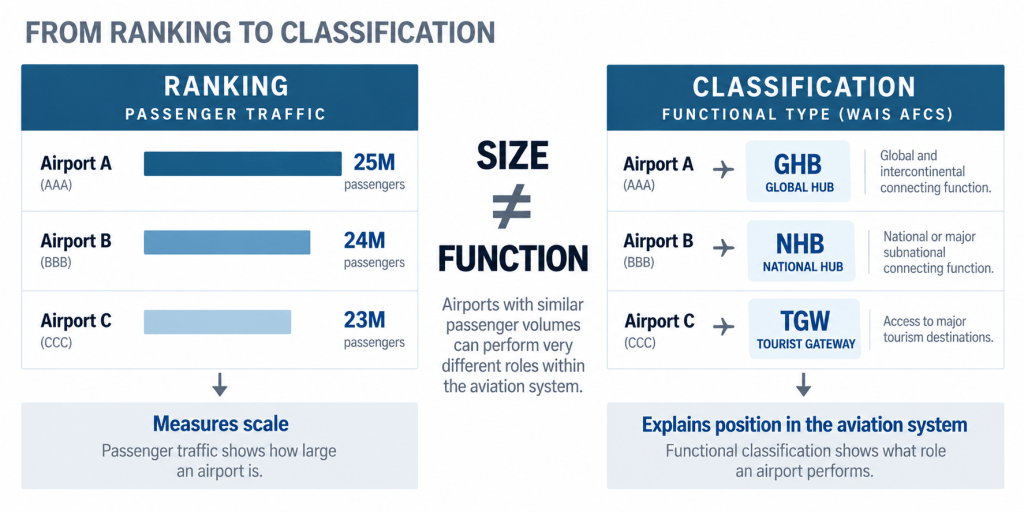
SIMILAR TRAFFIC, DIFFERENT AIRPORTS
The distinction becomes particularly important when airports with similar passenger volumes are compared.
A traffic ranking places airports next to one another because they handle similar numbers of passengers. Functionally, however, they may belong to very different parts of the aviation system. Their international reach, connecting role, relationship with airlines, position within a national network and relationship with neighbouring airports may differ substantially.
Conversely, airports performing broadly comparable functions may differ greatly in passenger volume because they operate in countries and regions with different population sizes, levels of air travel and network structures.
Functional classification therefore introduces a dimension that cannot be recovered simply by dividing airports into traffic bands. Size and function are related, but they are not interchangeable.
A COMMON LANGUAGE FOR COMPARISON
Classification becomes particularly valuable in a global system because airport terminology is not standardized internationally.
National aviation authorities classify airports for different purposes and according to different criteria. Administrative status, infrastructure, international designation, traffic thresholds and network importance may all be used, but the resulting categories are not necessarily comparable between countries.
WAIS retains national classifications as an important layer of airport information while applying a separate functional framework designed for comparative global analysis.
This makes it possible to examine an airport simultaneously through different perspectives: its passenger scale, its national classification, its geographic position and its functional role within the wider aviation system.
The objective is not to replace national systems, but to provide a common analytical language across them.
CLASSIFICATION AND THE WAIS FRAMEWORK
Functional classification is one component of the broader WAIS representation of airports.
Passenger data describe scale. Geographic data locate the airport within regional and national systems. Multi-Airport Systems describe relationships between airports serving the same metropolitan market. Airline and destination data describe network connections. Functional classification brings these dimensions together to identify the broader role performed by the airport.
This layered approach is central to WAIS. Rather than reducing an airport to a single rank or category, it allows different dimensions of the same airport to be analysed together.
The result is a framework in which rankings and classifications complement one another: rankings measure scale; classification interprets function.
ABOUT THE FRAMEWORK
The WAIS Airport Functional Classification is designed as a comparative framework for examining airport roles across different countries and world regions.
It is analytically separate from passenger rankings. An airport’s position in the WAIS World Airports Ranking 2025 is determined by passenger traffic, while its functional classification describes its role within the aviation system.
The framework also remains distinct from national airport classifications. WAIS records national classification systems where applicable while maintaining a common functional layer for international comparison.
The methodology, terminology and classification principles are documented in WAIS 001 — Airport Functional Classification: Concepts, Systems and Methodology.
WAIS 001 · AIRPORT FUNCTIONAL CLASSIFICATION
Explore the WAIS classification framework
Airport Functional Classification: Concepts, Systems and Methodology presents the concepts, terminology and analytical framework used by WAIS to compare airport functions across the global aviation system.

