WAIS INSIGHT · AIRPORT RANKINGS
The World’s Largest Multi-Airport Systems in 2025
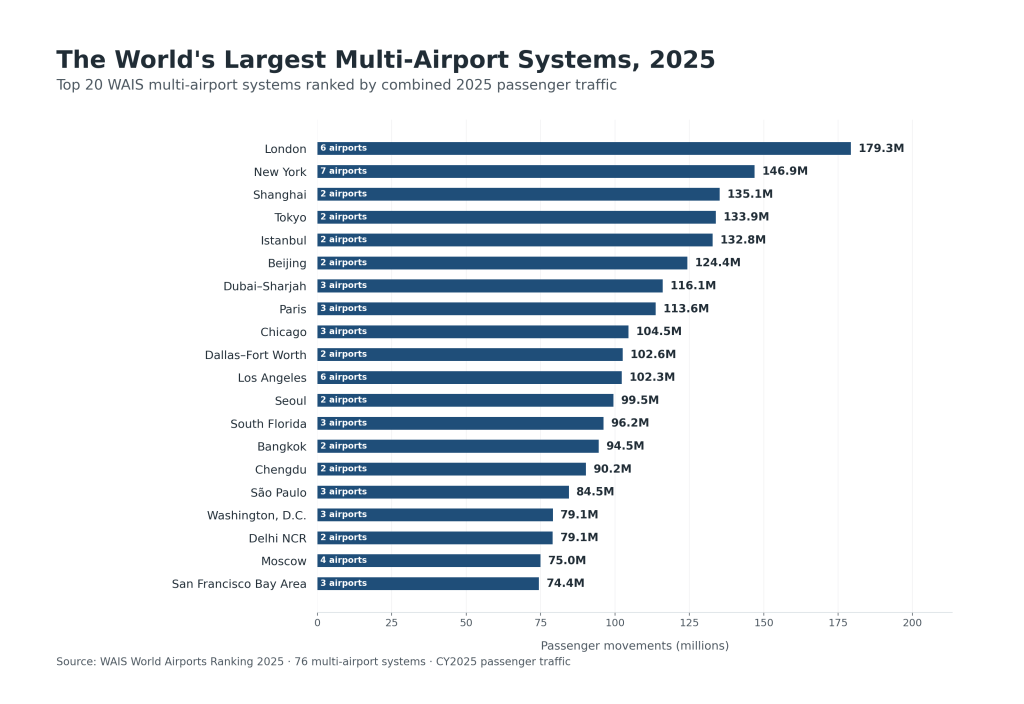
The world’s largest cities are increasingly served not by a single airport, but by complex systems of multiple airports. In 2025, WAIS identifies 76 multi-airport systems worldwide, with the largest handling well over 100 million passenger movements across several airports serving the same metropolitan area.
2025 DATA · MULTI-AIRPORT SYSTEMS · PASSENGER TRAFFIC
KEY FINDINGS
179.3M
LARGEST SYSTEM
London · 6 airports
146.9M
SECOND LARGEST
New York · 7 airports
11
SYSTEMS ABOVE 100M
Eleven multi-airport systems handled more than 100 million passengers in 2025.
76
MULTI-AIRPORT SYSTEMS
WAIS identifies 76 metropolitan airport systems worldwide.
SCALE BEYOND A SINGLE AIRPORT
Multi-airport systems change the way metropolitan aviation scale is measured. London handled 179.3 million passenger movements across six airports in 2025, while New York recorded 146.9 million across seven. Neither total describes a single airport: it represents the combined aviation system serving a major metropolitan region.
The same pattern appears across several of the world’s largest urban aviation markets. Shanghai, Tokyo, Istanbul and Beijing each exceeded 120 million passengers when their airports are considered together. Dubai–Sharjah, Paris, Chicago, Dallas–Fort Worth and Los Angeles also surpassed 100 million.
The composition of these systems varies substantially. Some are dominated by two very large airports, while others distribute traffic across several major and secondary airports. London and Los Angeles each contain six airports in the WAIS system definition, New York seven, while Shanghai, Tokyo, Istanbul, Beijing and several other leading systems consist of only two.
HOW THE LARGEST MULTI-AIRPORT SYSTEMS ARE BUILT
DIFFERENT CITIES, DIFFERENT AIRPORT SYSTEMS
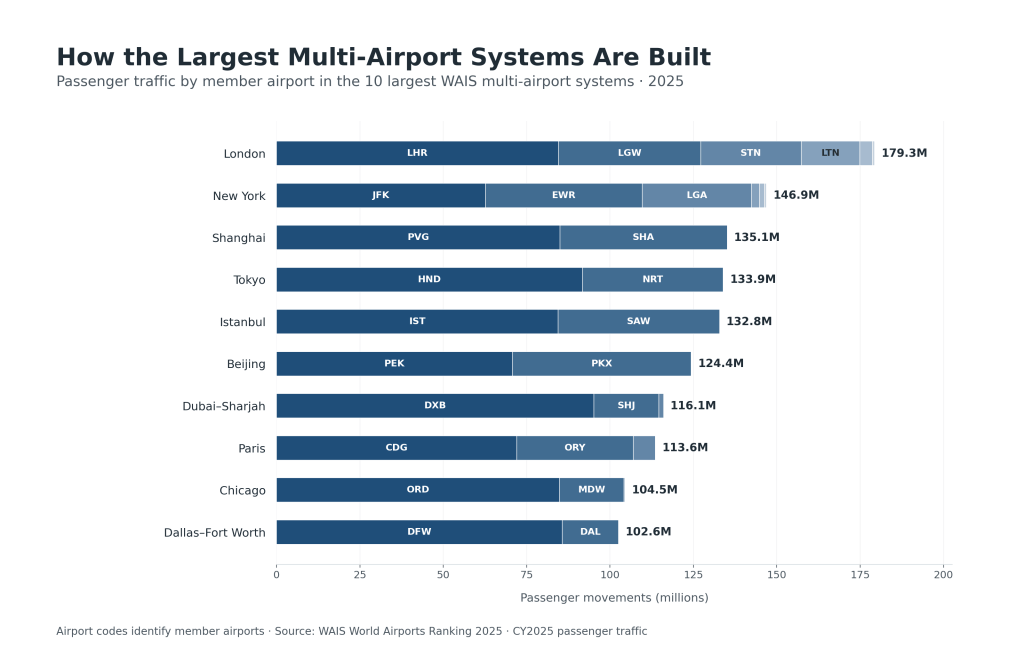
The world’s largest multi-airport systems are not built in the same way. Similar metropolitan passenger totals can emerge from very different distributions of traffic between individual airports.
Some systems are strongly dominated by a single primary gateway. In Dubai–Sharjah, DXB handled 95.2 million of the system’s 116.1 million passengers in 2025. Dallas–Fort Worth shows a similar pattern, with DFW accounting for 85.7 million of 102.6 million, while Chicago is dominated by ORD with 84.9 million of the system’s 104.5 million passengers.
Other systems divide traffic much more evenly between two major airports. Shanghai combines PVG (85.0 million) and SHA (50.2 million), while Beijing combines PEK (70.7 million) and PKX (53.6 million). Istanbul similarly distributes substantial traffic between IST (84.4 million) and SAW (48.4 million).
London and New York represent a different model. Their metropolitan traffic is distributed across several airports rather than concentrated in only one or two. London combines six airports in the WAIS system, while New York contains seven. This makes the structure of the system, rather than the size of any individual airport, essential for understanding the true scale of metropolitan aviation.
THE PRIMARY GATEWAY AND THE ALTERNATIVES
WAIS treats a multi-airport system as more than a statistical aggregation of airports serving the same city. Airports within a system may perform different metropolitan functions.
A Primary Metropolitan Gateway (PMG) represents a principal gateway within the metropolitan aviation system. Alternative Metropolitan Gateways (AMG) provide additional capacity or differentiated access to the same metropolitan market. Mixed-System Role (MSR) is used where an airport combines metropolitan functions that cannot be represented adequately by a simple primary–alternative distinction.
These roles help explain why metropolitan airport systems develop differently. Traffic may be concentrated at one dominant gateway, divided between two large airports, or distributed among a wider hierarchy of primary, alternative and specialized airports.
THE GEOGRAPHY AND FUNCTION OF MULTI-AIRPORT SYSTEMS
Multi-airport systems differ not only in scale, but also in the way traffic and metropolitan functions are distributed among their constituent airports. London and Moscow provide two examples of how airports with different traffic volumes and system roles combine to form a single metropolitan airport system.
In London, six airports form the world’s largest multi-airport system by passenger traffic in 2025. Heathrow (PMG) is the largest component, followed by Gatwick (PMG), while Stansted (AMG) and Luton (AMG) provide substantial additional traffic. London City (PMG) occupies a much smaller but distinct position within the system, while Southend (AMG) represents its smallest component. Together, the six airports handled 179.3 million passengers.
Moscow presents a four-airport system with a different distribution of traffic. Sheremetyevo (PMG) is the largest component, followed by Vnukovo (PMG) and Domodedovo (PMG), while Zhukovsky (AMG) forms a substantially smaller alternative gateway. Together, the four airports handled approximately 75.0 million passengers in 2025.
The two examples show why a multi-airport system cannot be described by combined passenger traffic alone. Its structure also depends on how traffic is distributed among airports, which metropolitan roles those airports perform, and how they are positioned geographically within the system.
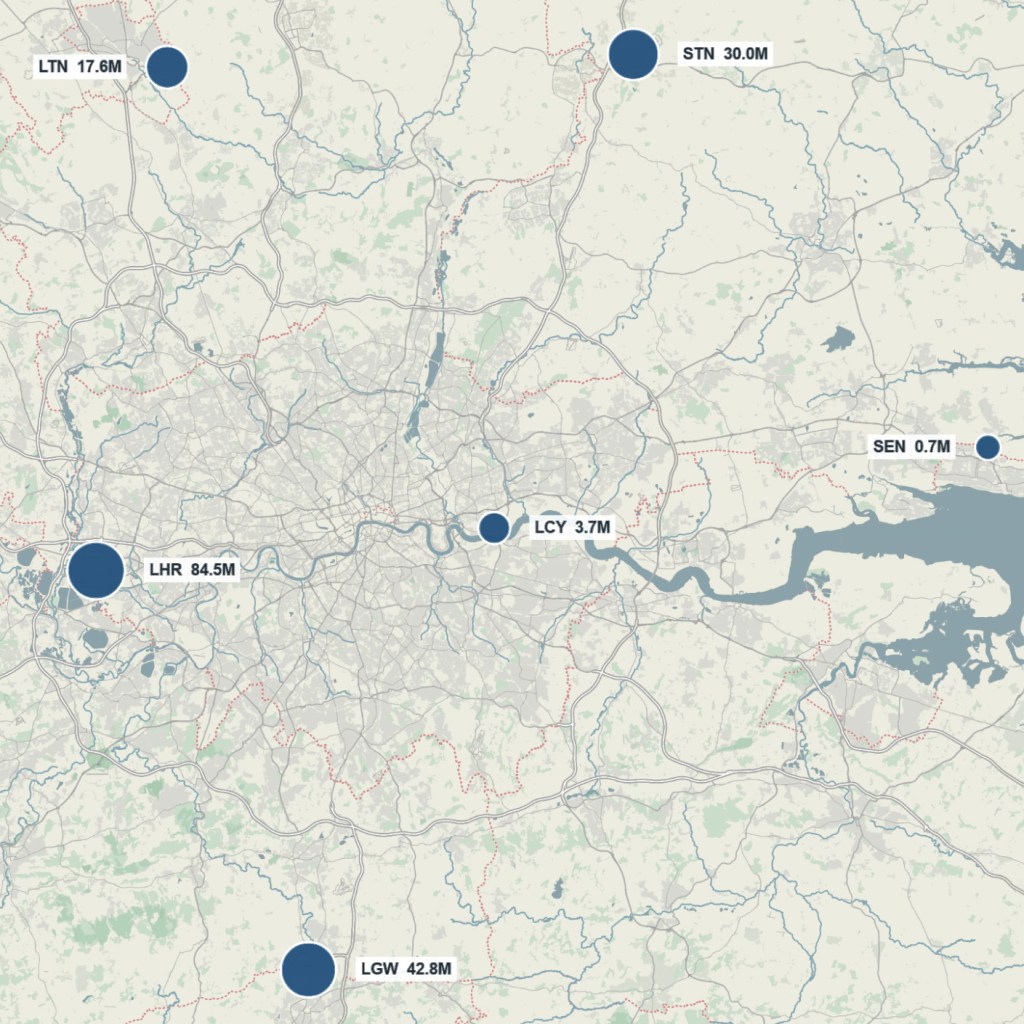
London Multi-Airport System
Six airports · 179.3 million passengers · 2025
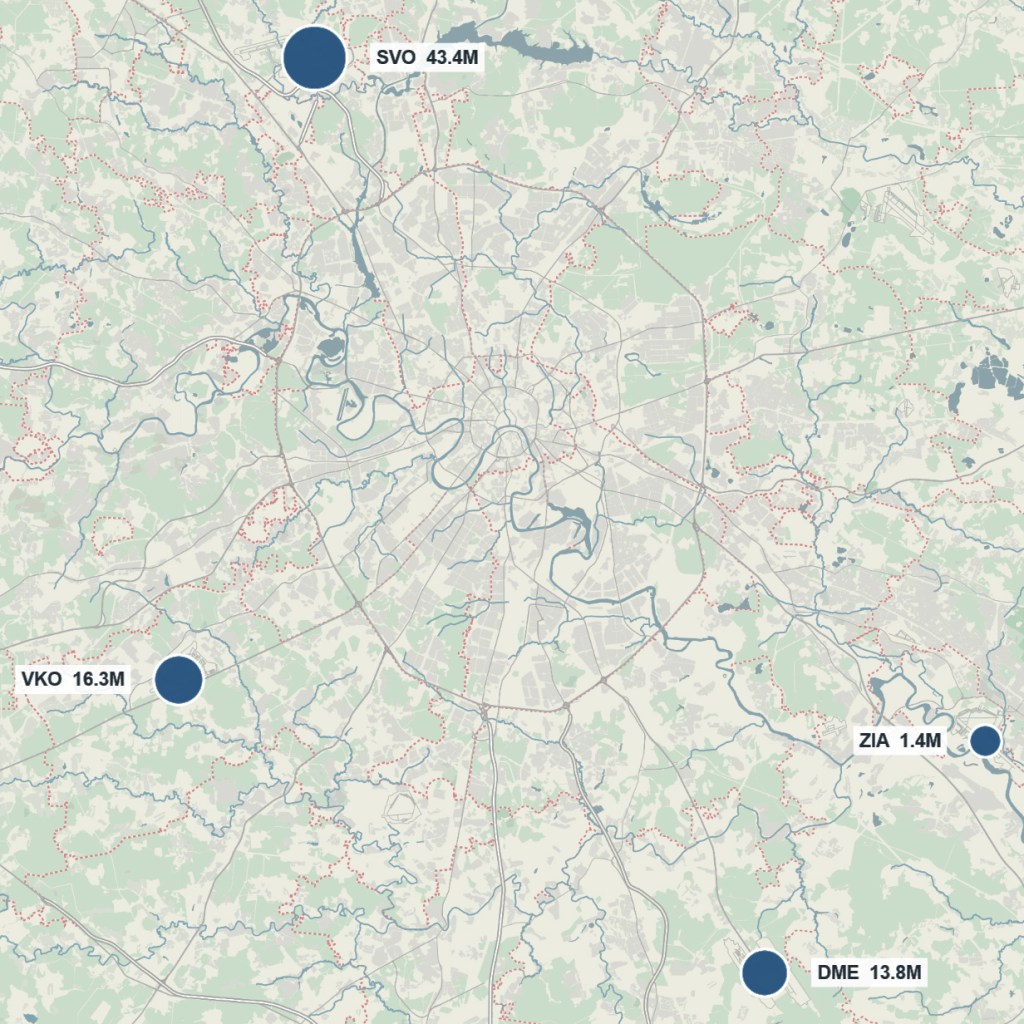
Moscow Multi-Airport System
Four airports · 75.0 million passengers · 2025
ABOUT THE DATA
The analysis is based on the WAIS World Airports Ranking 2025 and the WAIS Multi-Airport Systems framework. Passenger figures represent calendar-year 2025 traffic wherever full-year data are available, using the WAIS source hierarchy and estimation rules where necessary.
WAIS identifies 76 multi-airport systems worldwide. System totals combine passenger traffic at the airports assigned to each metropolitan system. Unlike the main World Airports Ranking, which covers airports handling at least one million passengers annually, a multi-airport system may also include smaller airports where they form part of the metropolitan airport structure.
Individual airports within each system are additionally classified by their metropolitan system role. This allows the analysis to represent not only the combined scale of metropolitan aviation, but also the functional structure of the airports that constitute each system.
WAIS 003 · World Airports Ranking 2025
Explore the complete global airport system
The full WAIS 003 publication provides rankings, regional analysis and structured data for 951 airports and 76 multi-airport systems worldwide.

